All posts by acl91

SO YOU’RE GOING TO A TOURNAMENT…

This slideshow requires JavaScript.

If you may be new to competitive tournaments or card games in general, I’d like to inform you of everything that you need to take to a local or large scale tournament. While local tournaments and majors and completely different beast, most of the items you will bring to both levels of play.  Going through this slide show will show you everything that is important and why you need to have this at a tournament. Each slide will have a tl;dr description proceeding a number of *s, the more *s the more important it is. I will also go in depth over the differences of both levels as well as the reason for bringing each item at each level.

At the local level is a lot more relaxed compared to major tournaments. These tournaments usually happen weakly if not daily so there’s less pressure if you end up forgetting something one day. Generally you’ll always bring your deck (sleeved) as well as your backpack. If you forget your playmat or a sleeve breaks, another player or the shop should have some you can borrow. Trades are always good to bring because you never know if someone pulls a card you want that you could have traded for. Overall it’s usually not a very competitive environment so you don’t need to worry about bringing any extra cards you don’t want, unless you want to make some last minute changes.

Major events such as championships or a regional are both extremely competitive and you will have a bad experience if you are not well prepared, and that’s why I am here for you. Everything in the slide show should be brought, better safe than sorry. If your event is outside your area, make sure to plan ahead. If the event last more than one day, have a place to stay, getting a hotel room with friends is the best choice. The most important rule for this scenario is to make sure you get enough sleep, last minute practice will be worthless if you can’t wake up for the event. Eating breakfast will also help your performance throughout the day (read this article on breakfast’s effects on the body and mind) and it might be that extra cereal bar or banana that gets you into the top 8.


Experience in FDOM

This blog was a assignment for my Fundamentals of Digital Media class and I really enjoyed doing it. The purpose of the class was to expand our knowledge of the digital world, doing all sorts of activities involving social media, programming and the like. I love to talk about my hobbies, especially card games. While I prefer talking about my hobbies in video format, being pushed to do it in a blog style was really interesting and enjoyable. We were given many tools to use with this assignment and I would like to go over some of them, as well as my overall experience with both the class and assignment.

While we mainly used WordPress in class, we we’re given other resources to expand our knowledge. Social media promotion was heavily encouraged with all our blog posts. I chose to use Twitter to share my blog post, but other social media sites and apps were available such as Instagram, Facebook, etc. These were useful for casting a larger net in order to drive as much traffic as possible for our blog. We were also introduced to website building with HTML. While it was different from the coding experience I’ve had prior, it was very interesting nonetheless, very much like trying out a new card game for the first time.

This assignment along with the class was overall a great experience and I felt like I learned more than I thought I would all the while having fun doing the assignments. I can’t express my how grateful I am for this class, since at the beginning of the semester I was worried if I would just end up changing major again.I was Computer Science major previously and since taking this class I’ve come to realize full-heartedly that this was a major I could see my making a career from. My professor Dale, as well as my lab instructor Kira were both great and taught me a lot, while making the class fun at the same time. We had several speakers from our future fields come in and talk to us, and each and everyone of them gave us good advice as well as made me look forward to graduating.

Vanguard’s Civil War

It’s been just over half a year since the reboot for Cardfight!! Vanguard in which it implemented multiple formats for the game, Standard and Premium. Standard is the format that only allows for the use of the newer V-series cards. Premium on the other hand allows the use of all cards released. Since then the community has been more or less divided on which format is better and should be the focused format for tournaments outside of BCS (Bushiroad Championship) and Spring Fests. I’ll be looking at at both formats and analyze how the format contributes to the community, its positives and negatives, as well as how competitive the format is for each.

Standard is the newest format to the game and saw a lot of polarizing opinions when it was first announced with the reboot. Half of the community (myself included) praised the reboot and new format for the fact that it would bring in new players as well as balance the game. On the other side of the fence however, many players were complaining that their old cards were worthless and a decent amount quit the game. Coming from the end of the G-era of Vanguard and reboot seemed refreshing, the game had been extremely power-creeped over the past two sets with Ultimate Stride and Divine Dragon Apocrypha bringing in Zeroth dragons. However, that refreshing feeling of a balanced game wouldn’t last for long as most players came to find out that clans such as OTT and Kagero, two of the first decks released in the reboot, would remain two of the top decks to this day, while other decks would remain at the bottom tier even with new support. It was clear to everyone that Bushiroad’s favor system was not going to change with the reboot and combo that with Standard’s game-play relying more on variance than player skill deterred a lot of the more competitive players to keep playing the format and because of that the first couple of ARG (Alter Reality Games) events were solely Premium.

As far as the history of Premium so far, you can flip most of the points from the Standard paragraph and there you go but let me go into more detail. In the beginning most players were going to play Premium until their favorite clan came out for Standard which they would then switch over. Most labeled Premium as a bandage for Bushiroad to keep its player-base until all the clans would be released into the Standard format. However, after most of veteran player-base got over their honeymoon phase (again myself included) they started seeing the flaws with Standards current competitive viability. Standard only had a dozen different clans that could be played as well as a smaller available card pool which led to little creativity in deck-building. This led to the meta constantly being dominated by 2-3 decks, compared that to Premium and the grass looked a lot greener. Premium had the advantage of a huge card pool which led to a very diverse metagame. Even clans that had no support from the V-series such as Bermuda Triangle were being played and having success within the meta.

It is with a heavy heart that I would like to say that neither format is currently in great spot. While Standard is releasing more clans and we are having a bit more diversity, we are still facing the problem of the game being heavily luck dependent which creates a very boring competitive game state. Although its getting better, I feel as though the Standard format still has a long way to go before it gets back to Vanguards glory days. For all the praise I gave Premium it has slowly gotten out of hand with players figuring out more and more degenerate deck builds that seem to break the meta. Decks such and NLK loop and the various Gyze decks have taken over the metagame bringing us from the diverse meta we had at the start of the reboot. Despite all of this, I am still playing the game and supporting both formats. While we may lose some players along the way, i know that Vanguard can get back to its glory days. Just remember to keep playing, keep improving.

Overestimating Your Favorite Deck

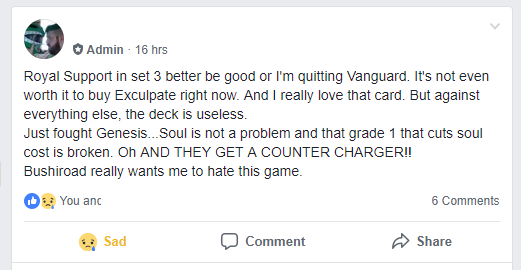
For some of you, your favorite deck might be Royals, Nova Grappler or another table 200 deck and you might be dissatisfied with the lack of competitive representation your deck gets. You might think the deck is super good, you think the only reason people aren’t playing your deck at bigger tournaments is because they are building it or playing it wrong. You add in all these techs you think are super good you practice at home, and go to a tournament with it, and you get swept. You get frustrated and start blaming your loses on irrelevant scenarios. Truth of the matter is, no one is underestimating your deck, you are just overestimating your deck.

This has recently hit one of my close friends, who I’ve known since I started playing Vanguard six years ago. He was unhappy at the current state of Royals in the standard meta. He’s always loved the clan, and when his favorite card Exculpate the Blaster came out, he was thrilled with card and ready to play with it. However, when the deck failed to perform against the better decks of the format, he felt frustrated, blamed all the other decks for being too over powered and wanted to quit the game. Royals ever since the start of the reboot have never gone past B-tier in the standard format and this round of support did little to change that. If you find yourself in that mentality, the best advice anyone can give you is to simply step away from your comfort zone and try other decks. It’s a shame you can’t play your favorite deck but if losing is bad enough to completely ruin the game for you this a good way too go. You might even find that the new deck you play could be your next favorite.


Now, why is my favorite deck not competitive or have any top placings? I’ll keep this one brief since Youtuber, dzeeff, goes about it good detail in his video, “Why Nobody Plays Your Favorite Yu-Gi-Oh! deck,” (he refers to Yu-Gi-Oh! but it can apply to any card game) . In short, when someone who goes to large-scale competitive events where they have invested money in either an entry-fee, gas to drive to the location or hotel reservation they want to have the best chance to win to make their expenses worth it. This usually means using a top-tier deck over a deck in the lower tiers because that increases the odds of them topping at the event. Myself personally will always choose to use one of the top 3 decks at the time whenever I attend one of these events even if it is not my favorite deck to play. For example, at the Texas BCS 2018, I chose to use OTT over my current favorite deck at the time which was Nova Grapplers because I knew I had a higher chance of winning. While I only came in top 20 (just bit shy of the top 8 cut-off), I knew if I had use Novas I most likely would not have made it past the first few rounds.

I don’t mean this to be coming off as me just saying your favorite deck is bad. If you would simply like to play the game at a local or casual level and winning isn’t a priority for you, play whatever deck you want, but if you want to take your game up a notch and compete, don’t be surprised when your low tier deck fails to perform.

Online Vs Traditional Card Games

46485570_877239885815308_7410210008975015936_n.jpgTraditional trading card games have ran into a competitor that could very well take it’s top place spot in card game popularity. No, I am not talking about solitaire you would play when the internet cut out. I’m referring to the online card games such as Yu-Gi-Oh! Duel Links, Shadowverse and the big daddy of the bunch, Hearthstone, etc. These online card games have immensely risen in popularity over these past few years and rivaling their predecessors player base. But what are the differences between these online card games and traditional card games and what are the advantages of online card games.

What are the key differences between these two platforms of card games, they can’t be to different, nut you’d be surprised. Unlike traditional card games where you would have to find someone in real life to play card game you play (not getting into finding someone that plays the same format you do), online card games are well online. That means that as long as you have the game installed on your device and have an internet connection you can play against anyone from around the world whenever you want, where you want to. This is extremely convenient and its the main selling point for most people when they want to choose between traditional or online card games. Some could argue that the lack of person to person interactions is a disadvantage but you’ll come to find out that the number of people on that side of the argument is relatively smaller.

Another selling point for most players is the accessibility to cards compared to traditional card games. If you want to play traditional card games you will always have to start by using real life currency to purchase cards, either packs or single cards. However, online card games are free to download and you can purchase packs or individual cards with in-game currencies that you can generally get for free by simply playing the game, and most often than not these games will give you free stuff when you start playing to help you get in to the game. Now if you want to be more competitive these games might need you to spend some real life currency to get more cards, this is where the term “freemium” comes in. Freemium isn’t a term only true to online card games, this used for any game that is free to download but has a certain paywall if you would like to get competitive with the game, Duel Links and Hearthstone are two card games guilty of this.

Meta Breakdown: Vanguard’s Standard Format Post Strongest! Team AL4

With four new clans getting added to the standard format, two for Dark Zone Pale Moon and Dark Irregulars, Dragon Empire’s first ninja clan, Murakumo and United Sanctuary’s edgy poster boys, the Shadow Paladins. This is also the first non-extra set since BT01 with Unite! Team Q4. Not all clans are created equal and while Bushiroad has done a way better job at balancing the game than the past influx of Gear Chronicle support every other set back in the G-era, clans that were good on release have stayed good and clans that were bad have stayed bad. Shadow Paladin and Murakumo have been making waves in the standard meta while Pale Moon and dark Irregulars are still only mid tier at best. What separates these clans form the rest, what makes them good and what makes them bad?

Let’s start off by taking a look at the new fresh kids on the block, Shadow Paladin and Murakumo. Shadow Paladin has always been a fan favorite since its very first release in BT04’s Eclipse of Illusionary Shadows with their black armor and edgy counterparts of popular Royal Paladin units like Blaster Blade and Alfred Early. Now, while their popularity does play into the amounts of tops they get, they are indeed a good clan mechanically as well. Shadow Paladins focus on retiring their own rearguards in order to plus in card advantage by forcing their opponent to retire his/her own units. They are an Accel clans worse enemy, as in whatever rearguards the opponent plays will just fuel the flame for their boss unit Phantom Blaster Dragon. Murakumo doesn’t have as many good match-ups as Shadow Paladin but they have particularly good match-ups against top competitors in the likeness of Dimension Police and the fabled Oracle Think Tank (OTT). Murakumo’s main combo revolves around their main boss unit Dueling Dragon, ZANBAKU and Left and Right Arresters locking down the opponent from standing and/or riding. This is a big blow to Dimension Police and OTT since their play style revolves around re-riding the vanguard to start a snowball towards their win-condition.

One the other hand clans such as Pale Moon and Dark Irregulars are struggling to top despite them being new clans. Pale Moon suffers the same problems as all the other Accel clans. They have really explosive turns that can devastate the opponent but a defensive trigger or two and their turn is as good as done. Dark Irregulars have some pretty decent cards, as all the protect clans do, but just like Megacolony that is as good as they get, decent. No Life King, Death Anchor is definitely the bread and butter of the deck but it’s re-ride ability is just to slow to consistently get off before your opponent is far enough ahead to matter. Now with all this information at your disposal, I’d like to remind you all that ARG Fall States for the standard format is taking place on the weekend of November 3-4, more info at argcircuitseries.com.

Meta Breakdown: Vanguard’s Premium Format Post Strongest! Team AL4

With the release of Strongest! Team AL4, and the Fall State ARG Championship tournaments happening next week, for more information argcircuitseries.com, It would be a good idea to catch up a familiarize ourselves with the upcoming meta. We will be talking about what decks to watch out for and how these new cards have affected the tierlist. We will also be looking over what combos they take advantage of and potential counter play tech cards you could throw in to your deck to better combat them. One thing to remember is that even if your deck isn’t top tier, Vanguard is a game with variance built into it’s core game mechanics and even a low tier deck can edge out a victory against the top competitors.

Let’s start off with the two tier 1 decks that have annihilated the competition, taking most of the tops in each Bushiroad World Championships around the globe as well as ARGs since the start of the reboot: OTT-Gyze and Ange-Trois. Gyze is the ultimate defensive deck and pair it with OTT’s new scry abilities and draw power from cards like Imperial Daughter and CEO Amaterasu, the deck can keep it’s opponent with minimal resources and finish them off with Dragon Deity of Destruction, Gyze. When you’re playing against Ange-Trois, you pray that you win the die roll or that they can’t get their superior ride/stride combo with Spirited Star, Trois if not they can also aggressively push for game with Chouchou, Lucille plus Dreamer Dreamer, Kruk on a Chouchou Popular Favor, Tirua turns. If you think aggro is all they have going for them, you would be sorely mistaken. This deck is also a brick wall, it’s main grade 3 is Delight Genius, Ange who has the potential to plus you 4 cards to hand by herself, and cards like Luxury Wave, Elly, Attractive Glow, Sandy and Transcend Idol, Aqua make the deck impenetrable.

Now for the two decks that have made their presence know with just a few weeks of being out in Japan and taking several tournament tops already we have Dark Irregulars’ No Life King Loop and Shadow Paladin’s Luard. These decks were forces to be reckoned with back in the G-Era and now with their new support in Strongest! Team AL4 they are back to take their place b in tier 1. Luard was a always at least a tier 2 deck up until the end of G, being able to have essentially unlimited resources and also a good end game, it was the perfect tempo deck to control the game with. Cards like Dragsaver, Esras and Belial Owl would make sure they always had whatever they needed and always kept plusing and destructive finishers with the likes of Dragstrider, Luard and Dark Dragon, Phantom Blaster “Diablo”.  Our next new deck that has popped up and the most dreaded as of late is the dread No Life King, Death Anchor OTK loop. This is the fastest deck out at the moment with it being able to perform the combo on your second turn on grade 3. No Life King, Death Anchor’s interaction with Enigmatic Assassin during the battle phase means that as long as you have three Assassins in your hand, field or soul and a No Life King both on vanguard and soul or hand, you can attack with your vanguard and 40,000 power Assassins and long as you have counter blast to pay. Not many decks can deal with those amount of not only vanguard attacks but big rearguards as well, and if they somehow managed to live you could always finish them off with One who Splits Darkness, Bledermaus‘ skill of attacking twice and shuffling all grade 0s from soul and field back into the deck.

When it comes to countering the decks there are a few Cray Elementals that can do the job. For Gyze decks that deny you resources, Heat Elemental, Bobo gives you every resource Gyze is trying to keep from you in one card. When it comes to Bermuda’s Ange-Trois and the No Life King loop cards like Light Elemental, Honoly and Shadow Elemental, Bikkun can help you survive and outright shutdown their power-plays. As far as Luard goes they have such a large toolbox that there isn’t any one card or cards that can outright counter them and that’s ultimately what makes it such a strong deck. As long as you can keep the tempo, stop the Luard player from getting to far ahead and play your cards accordingly you can beat it. Pale Moon and Murakumo where the other two clans to come out of AL4 but they really haven’t made an impact on the meta outside of the Pale Moon Nightmare Doll deck that is mid-tier at best due to Accel Gift and the new Nightmare Doll, Alice. To reiterate, with enough luck and a good pilot even the low tier decks can take on and give these top tier decks a run for their money, just keep playing, keep improving!

QnA with Hunter “MapleBlade” Kaye

Hunter Kaye also know for the pen name “MapleBlade” was one of the first friends I had made in college during my freshman year. We met at a gaming club and quickly became friends over our passion for card games. I recently learned that Hunter had started writing articles and blog post similar to mine, except he chose to focus on Yu-Gi-Oh!. Being a close friend of his, I was able to conduct a short interview with him, here is what Hunter “MapleBlade” Kaye had to say.

Q. How long have you been writing?
A. I’ve been writing for five months.

Q. What made you choose to write about card games?
A. I write about card games because it helps me think about the more intricate processes. By finding a way to explain it to an audience, I find new ways to understand strategies. Also, I read similar strategy articles as a teenager, and those helped me as a competitor. I’d like to help people like that, too.

Q. When did this become a profession, did it take a while?
A. I started writing articles for my own blog, and when I published my second article, my current boss approached me and offered to pay to write articles on his website.

Q. Do you see yourself doing this in the future? If so, do you hope to reach other forms of media?
A. While I plan to continue to write about card games, I hope to use this experience to help with jobs like newspaper editing once I graduate.

Q. What’s your favorite thing about card games?
A. My favorite thing about card games are the diverse strategies you’re forced to think about. Probability, risk and synergy are just a few aspects that make card games complex. It continually teaches me how to approach situations logically, as well as thinking about what the situation looks like to my opponent. I’m very competitive, so it’s exciting when I can meet people who are passionate about card games too, and we can clash with the hard work we’ve put in.

It is truly impressive that just after a few months Hunter started getting paid for his articles, this just goes to show the quality of his work. Most card game players tend to play more than one card game at a time. If you play Yu-Gi-Oh! Or would like in-depth analysis on the game as well as help with decks and understanding the game better, I definitely recommend you go give Hunter’s articles a read. I definitely recommend the article on card advantage as that is a key concept to keep in mind when playing any card game.

Trading Card Game Terminology for Dummies

Learn How to Play Vanguard

The terminology of trading card games (TCGs) is very complex and can be considered its very own language. The terms are categorized into specific groups withing the TCG community in order for you to have a better understanding of future posts and the community itself.


General

  • Card Advantage: Term commonly used to describe how many more cards you have control of over your opponent.
  • Salt: When you or your opponent is upset at the game; “I sacked my opponent and he was salty.”
  • Tilt: When you progressively start playing poorly due to being salty; “I was tilted after I got sacked last round.”
  • Chase rare: A card that is most valuable in a set of cards and is highly sought after by the masses; “The holographic Charizard is a chase rare and it’s worth $1 billion.”
  • Godpack: A pack of cards that contain the most sought after cards in a set; “It must be my lucky day, I just got a godpack.”
  • RNG/Variance: Describes the luck factors of a game.
  • Discard Pile/Graveyard/Drop Zone: A zone where cards go after they are destroyed or pitched.

Deck Building

  • Overpowered/Underpowered: Overpowered is used to refer to a card that is better than average, while under-powered is referred to a card that is below average.
  • Broken: Referred to a card or combination of cards that is so strong that it literally breaks the game.
  • Nerf/Buff: Nerf is to make a card or deck worse, while a buff is used to make a card or deck better.
  • Powercreep: When the next generation of cards are marginally better than the previous ones; “My deck used to be really good, but then it got powercreeped.”
  • Rotation: When a certain set of card are taken out of the standard game mode and is replaced with newer ones; “My deck is no longer usable in the standard game mode because half the cards got rotated out.”
  • Aggro: Short for aggressive, when a deck’s only focus is offense. Tends to win games in a shorter amount of time.
  • Control: When a deck aims to draw out the match as long as possible. Tends to win the long game.
  • Midrange/Tempo: Jack of all trades, master of none. Their power plays are more towards the middle of the game.
  • Combo: A deck that requires specific cards to make a power play.
  • Solitaire: A deck that does not require you to interact with your opponent.
  • Win-con: Short for win condition, a deck’s plan to attain victory.
  • Net-Deck: Copying someone else’s deck card-by-card. It is usually a practice looked down upon.
  • Tech: Specific card(s) that you would add to a deck for an advantage, not typically played by the majority; “My opponent didn’t see my spicy tech coming, and it won me the match.”
  • Hate Card: A sub-type of a tech. A card that you would add to a deck in order to specifically counter another deck; “My opponent knew he would be playing me so he added a hate card to his deck.”
  • Engine/Core: A group of cards that work to optimize a deck.
  • Archetype/Sub-Clan: A group of cards that are made to be  optimized when used together.
  • Meta: The decks that are the strongest in a period of time; “I have a higher chance to win because my deck is meta.”

In-Game

  • Draw: Drawing or to draw is to take the top card of your deck and put it into your hand.
  • High-roll/Low-roll:  In TCGs, a high-roll play is a play that has a high risk but has a small percent chance of yielding a high reward. Low rolling has little to no risk with a high chance at success but doesn’t reward you as much, and it’s simply playing it safe.
  • Brick:  This term is used when you have the inability to progress to your deck’s win condition with the current cards in hand; “I had a rough match since I bricked my first game.”
  • Sack(ed): When something luck based happens that that turns the tide of a game around; “I just got sacked! My opponent just drew the exact card he needed.”
  • Mulligan: At the start of a game you are able to return unwanted cards from your starting hand to your deck and draw back a certain amount of cards from the deck.  This allows you to have a greater chance of drawing cards you want.
  • Stack(ing): Is a term used for when a player deliberately controls the order of the cards in the deck outside the rules of the game.
  • Cut(ing): After a deck is looked through and shuffled, the opponent has the right to “cut” the deck, as in taking the top half of the deck and putting it at the bottom. This is to help prevent the opponent from cheating.
  • OTK/FTK: OTK stand for “one turn kill” where in the player wins the game in one turn. FTK stands for “first turn kill” and is a step-up from OTK as in the player wins the game on their first turn.
  • Mill: To take cards from the top of your deck and put it into the graveyard, drop zone or discard pile.
  • Burn: To deal damage to your opponent with out the need to attack them.
  • Mirror: Is commonly referred to a match where both players are playing the exact same deck. These can either be enjoyed and considered skillful or tedious and un-enjoyable.
  • Card Advantage:
  • Destroy/Board Wipe: Sending your opponent’s cards to the discard pile. Board wipe means to do destroy all your opponent’s cards leaving their board empty.
  • Banish/Bind/Exile: To take a card out of the game completely.
  • Deck-out: When you no longer have cards to draw from your deck. This usually lead to some kind of penalty for the player.
  • Tapped/Un-tapped: To indicate the state of a card. If a card is in a sideways position (tapped) it has been used. If a card is right side up (un-tapped) it can be used.
  • Spin: To put a card back into the deck.
  • Cost: A requirement that needs to be met in order for a card’s skill/ability to be used.
  • Misplay: For a player to perform an action in the game that is generally considered a poor decision; “I would have won that game if it wasn’t for my misplay.”
  • Pitch/Discard: To take a card from hand and put it into the discard pile.
  • Face: To deal damage to your opponent directly.
  • Eat: To destroy or banish your own cards.
  • Search: To add specific card(s) from your deck to your hand or board.
  • Cheese: Something that would under normal circumstances would not work but ends up working, usually leading to a win; “I thought I lost but then I cheesed my opponent.”
  • Hexproof: When a card is immune to other card’s skills/effects.
  • The Nuts/Godhand/Exodia: To have the best cards possible in hand; “I knew I won the game the moment I drew my opening hand, it was the nuts.”
  • Scoop: To pick up all your cards in a scooping motion and forfeit the match. “My opponent drew the nuts so I just scooped.

Tournament

  • X-1/X-2…: The “X” refers to the amount of wins you have in a tournament, while the the other number refers to your loses; “Person A: How are your rounds going? (never ask this question)
    Person B: I’m currently X-1.”
  • Bye: Happens when there is a odd number of participants in a tournament. A player has no opponent and receives a free win.
  • Weight: A numerical representation of whom you’ve won and lost against in the middle of a tournament.
  • Seed: A numerical representation of how good a player is based on weight.
  • Top Cut: After a certain amount of rounds in a tournament, there is a top cut in which the players with the highest weight advance.
  • Scrubbed Out: When you do not have enough wins to make it into the top cut; “I went X-3 and scrubbed out.”
  • Bubble-In/Bubble-Out: Bubbling in is to have the bare minimum amount of weight to make it in to the top cut, while bubbling out means to have almost have the bare minimum wait to make it to top cut; “I went X-1 but still managed to bubble out of top cut.”

Welcome to Cardfight!! Vanguard ATX

Hello, my name is Arthur Lago and welcome to Cardfight!! Vanguard ATX!

25348284_10159768242565707_1513913138514222999_n
Join us on Facebook

Vanguard is a card game similar to Yu-Gi-Oh!. Cardfight!! Vanguard ATX is a group dedicated for Vanguard players in and around the Austin,  Texas area. Our group was established (date) and I joined the group three months later.  I have since then seen the group grow and expand along with the game itself.

I have kept up and played the game since the its infancy. What I would like to talk about the game and the community surrounding it. I would like to share my experience with both people who actively play the game as well as people who show interest in the game. Overall I wanted to get more people involved with the community and game.

In the future I hope to extend my content to cover how the competitive environment evolves, along with the secondary market for card games. I will explain why the great decks are great, and why the bad decks aren’t, and use past experiences in the card market to explore which new cards are worth investing in.